
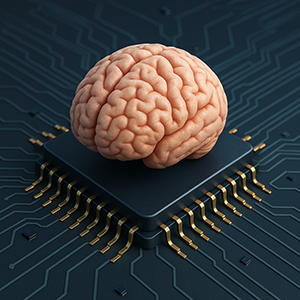

Artificial intelligence is everywhere right now. Consequently, everyone seems to have an opinion about it — especially when it comes to art. As an artist who uses both traditional acrylic painting and AI tools like Midjourney, Kling, and Nano, I have a unique perspective on this debate. In fact, I live it every day.
So let me break down the four key differences between human and artificial intelligence — and explain why I believe both have a place in the art world.
1. Origin and Nature
First, consider where each comes from. Human minds arise from biology — from millions of years of evolution, childhood experience, love, loss, and everything in between. AI, on the other hand, arises from code and silicon. It was built, programmed, and trained on data that humans created.
Therefore, when I pick up a brush and paint a bold pop art portrait in acrylic, every decision comes from a lifetime of experience. When I type a prompt into Midjourney, the result comes from patterns in data. Both produce art — but the origin couldn’t be more different.
2. Learning and Adaptability
Second, consider how each learns. Humans learn from life and context. For example, I learned about bold color and flat planes of color through years of painting, experimenting, and yes — failing. Moreover, I learn from conversations, emotions, and experiences that no dataset could ever capture.
AI, in contrast, learns from data and objectives. It processes millions of images and text descriptions to understand patterns. As a result, it can generate stunning visuals in seconds. However, it has never felt the satisfaction of stepping back from a finished canvas or the frustration of a color that just won’t work.
3. Consciousness and Emotion
Third — and most importantly — people feel and reflect. When I created my digital portrait of Frank Zappa, it wasn’t just a technical exercise. Zappa and I went to high school together. Consequently, every decision I made in crafting that prompt carried a personal weight that no AI could replicate.
AI simulates responses without inner life. It can produce an image that looks emotional. However, it doesn’t feel anything about the result. In contrast, I can stand in front of a finished portrait and be moved by it — because I remember the person, the moment, the story.
4. Creativity and Reasoning
Finally, consider creativity itself. Humans originate — we create something from nothing, driven by imagination, intuition, and emotion. AI recombines patterns from data we gave it. Furthermore, AI cannot decide to paint a celebrity portrait series because a sister made an offhand comment. That kind of spontaneous human decision is beyond its reach.
So where does that leave us? In my opinion, AI is an extraordinary tool — like a very sophisticated brush. Moreover, when a human artist directs it with intention, taste, and personal vision, the results can be genuinely beautiful. However, the art itself still comes from the human behind the prompt.
The Best of Both Worlds
I paint bold acrylic pop art portraits by hand on gallery-stretched canvas. I also create digital celebrity portraits using AI tools. Furthermore, I build sci-fi wallpapers that hide my own paintings inside futuristic scenes. In each case, the AI is my collaborator — not my replacement.
So next time someone asks whether AI will replace human artists, my answer is simple. It hasn’t replaced me yet. In fact, it’s made me more creative than ever.
Browse my art — both human and AI-assisted — at dennisrling.com →